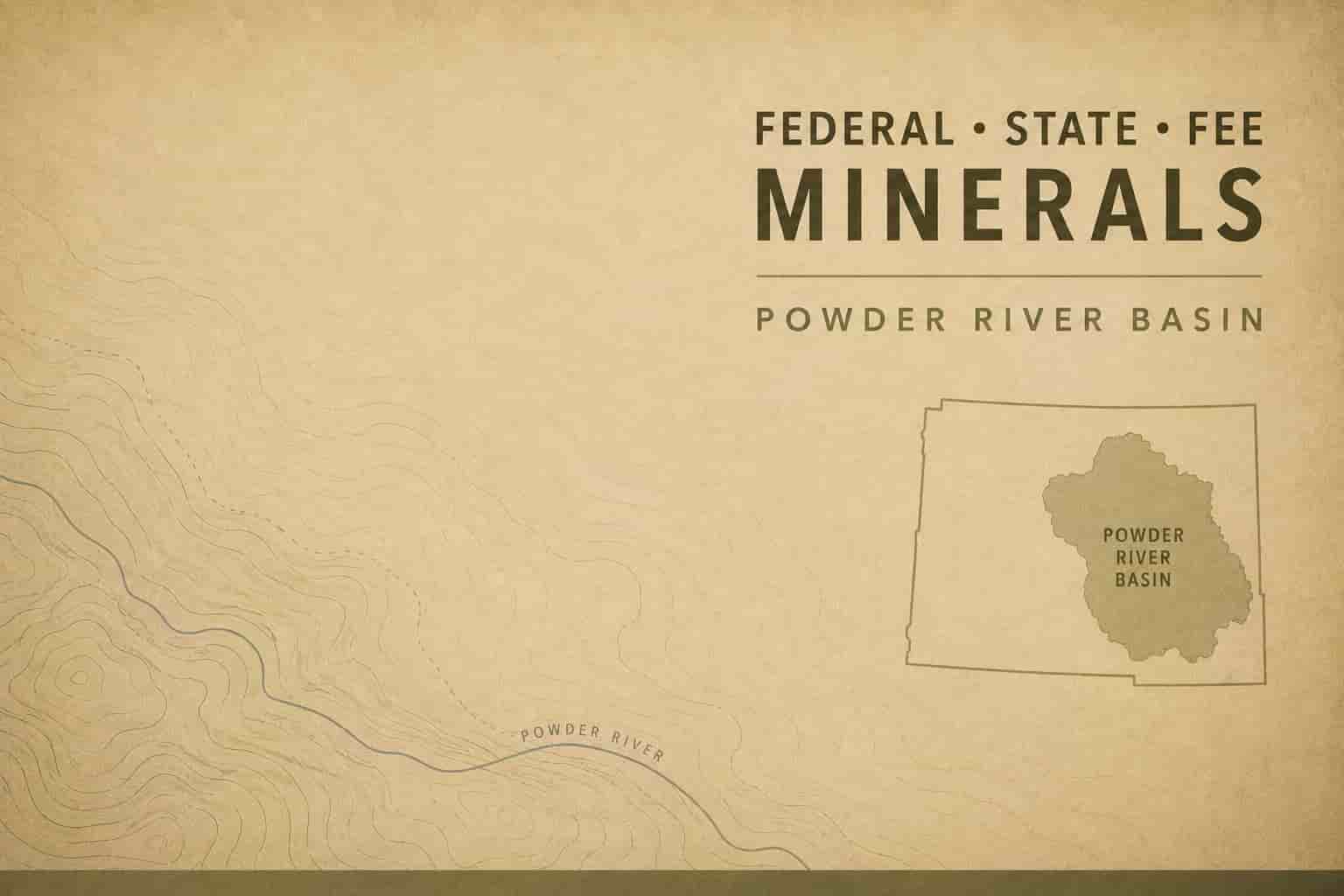
If you own or inherited minerals in the Powder River Basin, you may have noticed that the paperwork references something like a federal lease number, the Bureau of Land Management, or the State of Wyoming, and wondered what that means for you. The Powder River Basin is a patchwork of three different kinds of mineral ownership, and which one your minerals fall under shapes how they are leased and administered.
Here is what federal, state, and fee minerals are, why the basin is such a mix, and why the distinction matters.
Three kinds of mineral ownership
Underneath any tract, the minerals are owned by one of three broad categories of owner: the federal government, the State of Wyoming, or a private party (often called “fee” minerals). All three exist side by side across Converse and Campbell counties and the rest of the basin, sometimes within the same square mile.
A related idea worth knowing is the split estate, where the surface and the minerals are owned by different parties. Split estates are extremely common in the Powder River Basin, including cases where the federal government owns the minerals beneath privately owned surface.
Why the basin is such a patchwork
Much of the checkerboard pattern traces back to 19th-century railroad land grants, which conveyed alternating sections of land to railroads while the government retained others. Over time, surface and mineral ownership in those sections drifted apart and changed hands, leaving a mosaic of federal, state, and private ownership that still defines the basin today.
Federal minerals
Federal minerals are managed by the Bureau of Land Management. They are leased through the BLM’s competitive leasing process rather than by private negotiation, and production is reported to the federal government. Because so much of the basin’s mineral estate is federal, many leases here are federal leases, and many tracts are federal split estate: federal minerals beneath private surface, where a surface-use arrangement governs access.
State minerals
State minerals belong to the State of Wyoming and are administered by the Office of State Lands and Investments, which leases them on behalf of state trust beneficiaries such as public schools. State leases follow the state’s own process and terms, separate from both the federal system and private leasing.
Fee (private) minerals
Fee minerals are privately owned and leased by direct agreement between the owner and an operator, the arrangement most people picture when they think of a mineral lease. Development across all three categories is regulated by the Wyoming Oil and Gas Conservation Commission, which handles spacing and pooling regardless of who owns the underlying minerals. Our overview of Wyoming mineral rights and the WOGCC covers that framework.
Why it matters, and what you can do
Which category your minerals fall under affects how they are leased, who administers the lease, and how royalties are reported, even though the underlying geology is the same. For an inheritor, the documents you have are usually the place to start: a federal lease serial number, a State of Wyoming lease, or a private lease each points to a different regime, and the relevant agency or the operator can confirm what applies.
If you have Powder River Basin minerals and are not sure whether they are federal, state, or fee, we are happy to help you read what you have and make sense of it. There is nothing to sell to have that conversation, on a call or by email.
Questions about something you received?
Call us. We're happy to help you figure it out.
(737) 373-2547