Mineral Rights · Texas

Mineral rights
in Texas.

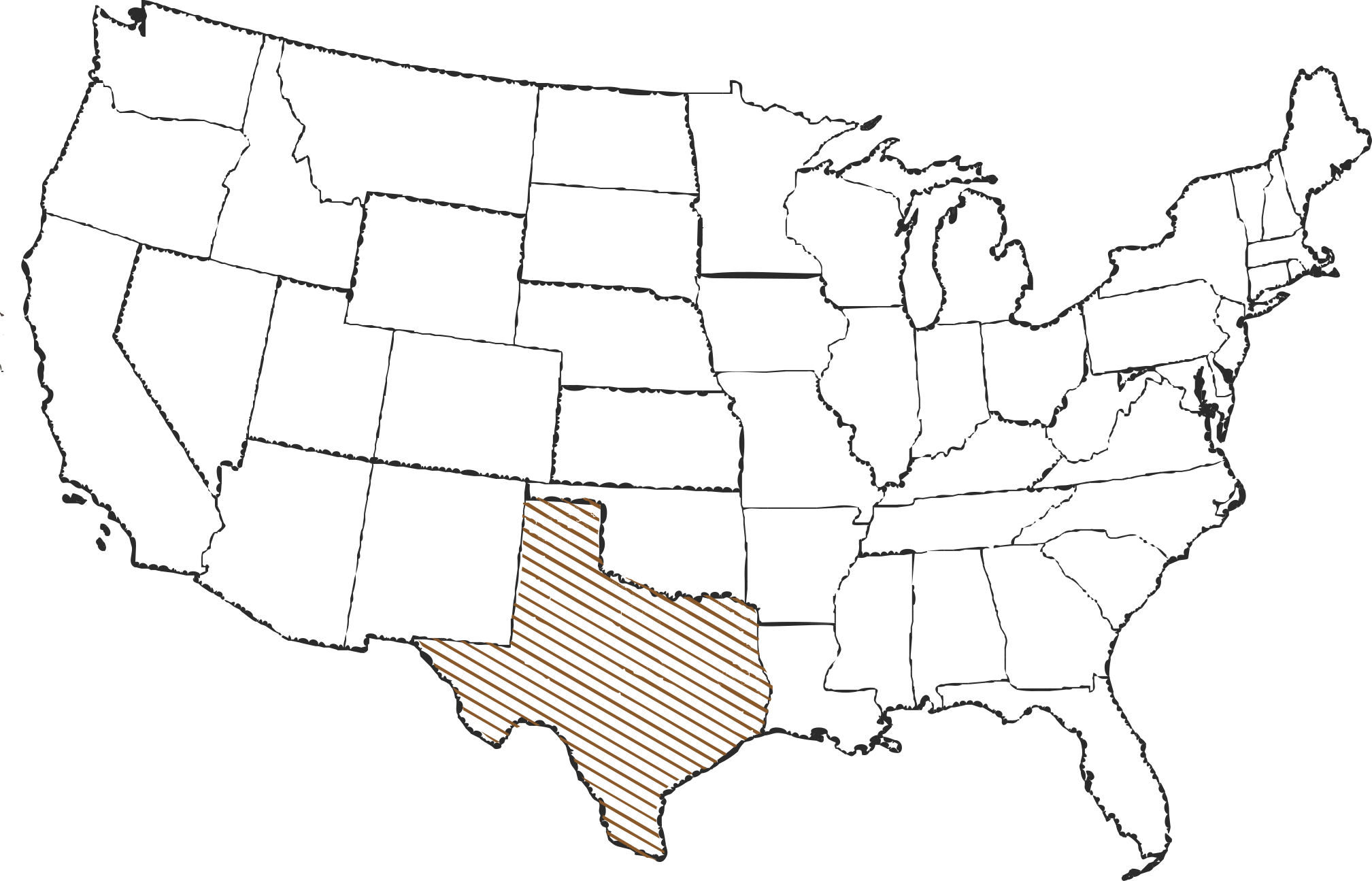
Texas produces more oil and gas than most countries. Mineral rights here are substantial, widely held, and often complex. Whether your minerals are in the Permian, the Eagle Ford, or somewhere else entirely, we are happy to help you understand what you have.

01

More basins than any other state.

Texas is the most productive oil and gas state in the country, and it is not close. Multiple world-class plays operate simultaneously across different parts of the state. The Permian Basin in West Texas is the current star, accounting for the majority of state oil production. The Eagle Ford in South Texas produces both oil and gas. The Haynesville in East Texas is a major dry-gas play. The Barnett near Fort Worth pioneered modern shale development.

Each of these plays has its own geology, its own operator roster, and its own typical mineral ownership patterns. A family that inherited Texas minerals might be in any one of these, or sometimes more than one.

Texas mineral law is also unusual. The state is strongly private-property-oriented, and mineral ownership is often separated from surface ownership through layers of historical transactions. Understanding what you actually own in Texas sometimes requires tracing back a century of deed records.

02

Multiple basins, each with its own story.

Texas has more significant oil and gas basins than any other state. The four below account for the bulk of modern activity, though meaningful production exists in others.

Permian Basin
The most productive oil basin in the US, covering much of West Texas and eastern New Mexico. Horizontal Wolfcamp, Bone Spring, and Spraberry development with some of the highest drilling intensity anywhere in the world.
Eagle Ford
A major horizontal play across South Texas. Oil, condensate, and gas windows across a band of counties from the Mexican border up toward East Texas. Mature but still active.
Haynesville Shale
A dry-gas play in East Texas and northern Louisiana. Deep, high-pressure horizontal wells with strong economics in high gas-price environments.
Barnett Shale
The original modern shale play, in North Texas near Fort Worth. Gas-focused, mature, with ongoing production from wells drilled in the 2000s and 2010s.
03

The counties that matter most.

Texas has over 250 counties, and oil and gas activity exists across many of them. The list below highlights the most active counties in each of the state's major plays.

Permian Basin
Midland County
Midland Basin

At the heart of the Permian's Midland sub-basin. Continuous horizontal drilling and substantial mineral royalty income.

View Page →
Permian Basin
Martin County
Midland Basin

One of the most active horizontal drilling counties in the country. Heavy Wolfcamp and Spraberry development.

View Page →
Permian Basin
Howard County
Midland Basin

A top Permian Midland producer with extensive Wolfcamp and Spraberry development. Sustained drilling activity and meaningful royalty income.

View Page →
Permian Basin
Reeves County
Delaware Basin

The Texas side of the Delaware sub-basin. Horizontal Wolfcamp and Bone Spring wells with high oil production.

View Page →
Permian Basin
Loving County
Delaware Basin

A small county with outsized Permian Delaware production. Active Wolfcamp and Bone Spring development with strong well economics.

View Page →
Eagle Ford
Karnes County
Eagle Ford Oil Window

A core Eagle Ford oil-window county. Longstanding horizontal drilling with meaningful ongoing activity.

View Page →
Permian Basin
Glasscock County
Midland Basin

Southern Midland Basin core. Stacked Wolfcamp and Spraberry inventory with a heavyweight operator base. Quality rock with sustained development activity.

View Page →
Permian Basin
Upton County
Midland Basin

Southern Midland Basin. Wolfcamp and Spraberry stack with some of the deepest drilling inventory in Texas. Operators here are among the largest in the country.

View Page →
Permian Basin
Andrews County
Midland Basin · Northwest Shelf

Northern Midland Basin meeting the Northwest Shelf. Stacked Wolfcamp and Spraberry inventory across most of the county, plus meaningful San Andres conventional production along the shelf.

View Page →
Permian Basin
Ward County
Delaware · Wolfcamp · Bone Spring

Central Delaware Basin core. Strong Wolfcamp A and 3rd Bone Spring Sand results across recent operator programs.

View Page →
Permian Basin
Winkler County
Delaware · Wolfcamp · Bone Spring

Northern Delaware Basin on the New Mexico line. Stacked Wolfcamp and Bone Spring development. County seat Kermit.

View Page →
Permian Basin
Culberson County
Delaware · Wolfcamp · Bone Spring

Western Delaware Basin frontier against the New Mexico line. Wolfcamp and Bone Spring development grading gassier to the west. County seat Van Horn.

View Page →
Permian Basin
Pecos County
Delaware · Central Basin Platform

One of the largest counties in Texas, split between the southern Delaware Basin and the Central Basin Platform. Modern Wolfcamp and Bone Spring on the west, deep gas and legacy Yates-area conventional on the east. County seat Fort Stockton.

View Page →
Haynesville Basin
Panola County
Haynesville · Cotton Valley

Texas Haynesville fairway in east Texas. Gas-weighted deep drilling tied to Gulf Coast LNG demand. County seat Carthage.

View Page →
Haynesville Basin
Harrison County
Haynesville · Cotton Valley · Bossier

East Texas Haynesville core. Heaviest-drilled section of the play on the Texas side. County seat Marshall.

View Page →
Permian Basin
Reagan County
Midland · Wolfcamp · Spraberry

Southwest Midland Basin with strong Wolfcamp and Spraberry stacked-pay results. County seat Big Lake.

View Page →
Eagle Ford
DeWitt County
Eagle Ford · Austin Chalk

Central Eagle Ford black oil and condensate window, among the most productive in the play. County seat Cuero.

View Page →
Eagle Ford
La Salle County
Eagle Ford · Austin Chalk

Volatile oil and condensate windows of the Eagle Ford in South Texas. County seat Cotulla.

View Page →
04

The operators of Texas.

Texas has more operators than any other state. The list below reflects major Permian, Eagle Ford, and Haynesville names, though hundreds of smaller operators also produce oil and gas across the state.

ExxonMobil / XTO
Permian · Multiple
Chevron
Permian
ConocoPhillips
Permian · Eagle Ford
Occidental
Permian
EOG Resources
Eagle Ford · Permian
Comstock Resources
Haynesville
Devon Energy
Eagle Ford
Texas has hundreds of active operators. The list above reflects the largest by production. Many smaller operators produce meaningful volumes across the state's basins.
05

Texas is a private-property state.

Texas has a fundamentally different oil and gas regulatory philosophy than most Western states. The legal tradition strongly protects private mineral rights, forced pooling is heavily restricted, and the state regulator has a long-standing pro-development posture. For mineral owners, this creates both advantages and complications that are specific to Texas.

State Regulator
Texas Railroad Commission (RRC)The state regulator for oil and gas, despite the name. Handles permits, production, plugging, and enforcement. One of the longest-established energy regulators in the country.
Records System
RRC online records and county-level deed recordsTexas has extensive public records at both the state and county level. County deed records are especially important for mineral title work, since the state's long history creates deep chains of ownership.
Pooling Process
Forced pooling is very limitedTexas does not allow compulsory pooling in the way most other oil states do. This strongly favors the mineral owner in lease negotiations but can also slow development when owners cannot be located.
Mineral Ownership
Typically severed from surfaceSplit-estate ownership is the norm across much of Texas. Mineral rights are commonly held by families who do not own the surface, sometimes through inheritance going back a century or more.
Rule of Capture
Applies to oil and gasTexas applies the 'rule of capture' (if a neighbor's well drains hydrocarbons from under your tract, you generally do not have a claim). This is one reason pooling and unitization are contractual rather than compulsory.
Own minerals in Texas

Let us take a look.

Tell us what county you are in and we will put together a plain-English analysis of what you have. No pressure, no pitch.