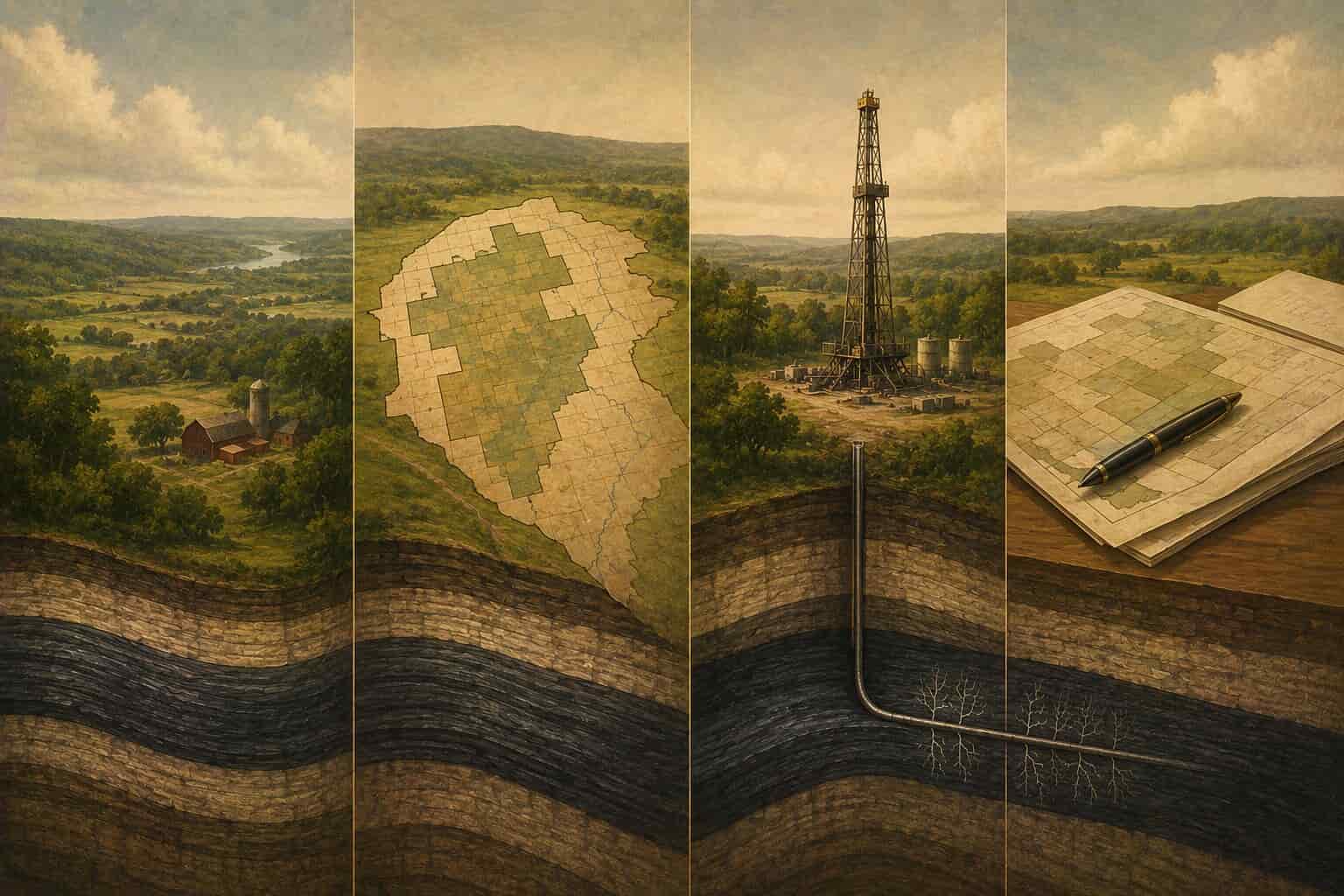
The Marcellus Shale is the largest natural gas field in the United States, and for hundreds of thousands of families across Pennsylvania, West Virginia, and Ohio, it is also the reason there is a royalty interest in the estate. If you own minerals over the Marcellus, or you inherited an interest and are trying to understand it, this guide explains the play from the owner’s point of view: where it is, what you likely hold, how dry-gas leasing and production work, the post-production cost issues that matter so much in Appalachia, and what is worth watching.
This is the practical guide, not a geology lecture. The aim is to help you read your own situation.
Where the Marcellus Shale is
The Marcellus underlies a large stretch of the Appalachian Basin, but the part that matters to owners is the productive fairway across the northern and central Appalachian states.
In Pennsylvania, the play has two distinct cores. The northeastern dry gas core runs through counties like Susquehanna, Bradford, Tioga, and Lycoming, and is among the most prolific dry gas areas in the country. The southwestern core, including Washington and Greene counties, produces wetter, liquids-rich gas and sits above Utica potential as well. For the state’s one-eighth royalty floor, the Kilmer rule on deductions, and leasing, see our guide to mineral rights in Pennsylvania.
In West Virginia, the Marcellus drives development across the north, including Marshall, Wetzel, Doddridge, Tyler, Harrison, and Ritchie counties, with the deeper Utica adding stacked potential beneath much of it. Our guide to mineral rights in West Virginia covers the cotenancy law and post-production deduction rules that shape a West Virginia royalty.
In Ohio, the Marcellus is present in the east but is generally secondary to the Utica Shale, which is the primary target in the Ohio core. Many Appalachian owners hold interests where both formations are in play, which is why the two guides are worth reading together.
What mineral owners typically hold
Most individual Marcellus owners hold one of a few kinds of interest.
A royalty interest is the most common: a cost-free share of production from wells on or pooled with your tract. If monthly checks arrive, this is what you have. Many of these are fractional, inherited interests, often divided among numerous heirs across several states after generations of estates.
Unleased minerals are interests never put under lease, or where a prior lease expired. In an active part of the fairway, unleased Marcellus minerals carry meaningful optionality because operators assembling units have reason to lease them.
Some owners hold an overriding royalty interest or a non-participating royalty interest, which behave differently for valuation and duration. If you are unsure which you hold, our guide to producing versus non-producing minerals is the place to start, and our walkthrough for people who inherited mineral rights covers how to begin when you have little documentation.
How dry-gas leasing works in the Marcellus
Leasing over the Marcellus has its own character, shaped by the fact that this is a gas play with a long development history.
Units are large and wells are long. Modern Marcellus laterals run two miles or more, so operators pool many tracts into large drilling units. Your interest may be a small decimal slice of a big producing unit, which is why a modest net acreage can still produce a steady check, and why a single tract can be touched by several wells over time.
Lease terms decide what reaches you. Royalty rate, primary term, Pugh clauses, and especially post-production cost language all matter. In the gas-weighted Marcellus, the cost language is often the single most consequential part of the lease for an owner’s net check. Our guide to reading an oil and gas lease covers the clauses that carry the most weight.
Pooling brings tracts together. If you are unleased in a unit an operator wants to develop, you may receive pooling or unitization notices. The mechanics depend on Pennsylvania, West Virginia, or Ohio law and the specific unit.
Post-production costs: the Appalachian issue
If there is one issue every Marcellus owner should understand, it is post-production costs.
After gas leaves the wellhead, it has to be gathered, compressed, processed, and transported to market. Those activities cost money. The central question for a royalty owner is whether those costs are deducted from your royalty before you are paid, or borne by the operator. The answer depends almost entirely on your lease language and on the law of your state.
This matters more in Appalachia than in many other regions, for two reasons. First, the Marcellus is dry gas in much of the fairway, and gas carries proportionally higher gathering and processing costs relative to its value than oil does. Second, Appalachian states have a long and unsettled history of litigation over whether and how these costs can be deducted, with different rules and key court decisions in Pennsylvania and West Virginia.
The practical implication for an owner is simple to state and important to act on: two owners with the same stated royalty rate on the same well can receive very different net checks, depending entirely on the deduction language in their leases. When you read a Marcellus lease, the cost-allocation and “cost-free royalty” language deserves as much attention as the royalty percentage itself.
How production and royalties behave
Marcellus wells follow the familiar shale curve: high initial production that declines steeply in the first year or two and then more gradually. Your royalty check tends to track that curve, larger when a well is new, smaller as it matures, and refreshed when new wells are drilled on the unit.
Because the Marcellus is overwhelmingly natural gas, royalty income moves with natural gas prices and with the cost of getting gas to market. The northeastern Pennsylvania dry gas core and the wetter southwestern Pennsylvania and West Virginia areas can carry different economics, so where your tract sits in the play affects the stream you receive.
What to watch as a Marcellus owner
Whether you intend to hold or are considering a sale, a few things are worth monitoring.
Drilling and permits near your tract. Nearby activity is the clearest signal that your minerals may see new wells. State regulators publish permit and production data.
Operator consolidation. The Appalachian operator landscape has consolidated significantly, and the name on your division order can change after a merger or acquisition. A well-capitalized operator with a development queue is generally favorable for an owner.
Your lease’s cost language and depth coverage. In stacked areas where the Utica sits beneath the Marcellus, whether your lease covers all depths or releases undeveloped ones shapes future potential, and the post-production cost language shapes your net check today.
Your records and contact information. Keeping your interest documented and your address current with operators is part of what a mineral owner is responsible for, and it prevents lost checks. If your interest is in West Virginia, cotenancy and multi-generation title fragmentation are common, which our West Virginia inheritance guide addresses, and the Pennsylvania inheritance guide covers Marcellus-specific issues there.
Common questions from Marcellus owners
Where is the Marcellus Shale? The productive fairway for owners runs through northeastern and southwestern Pennsylvania, northern West Virginia, and eastern Ohio (where the Utica is usually the primary target). The formation extends more broadly across the Appalachian Basin, but those are the areas with active owner development.
Is the Marcellus oil or gas? Almost entirely natural gas. The northeastern Pennsylvania core is dry gas; parts of southwestern Pennsylvania and West Virginia are wetter and liquids-rich. The gas weighting is why post-production costs and gas prices matter so much to the royalty.
Why is my royalty check smaller than the royalty rate suggests? Often because of post-production cost deductions. Gathering, compression, processing, and transportation costs may be deducted from your royalty depending on your lease language and your state’s law. Reading the deduction language in your lease is the way to understand your specific situation.
What is the difference between the Marcellus and the Utica? They are separate formations that often stack, with the Utica deeper. The Marcellus is the primary target across much of Pennsylvania and northern West Virginia, while the Utica and Point Pleasant are primary in eastern Ohio. Many Appalachian owners have both in play. See our Utica Shale guide.
I inherited a small Marcellus interest. Is it worth anything? It can be, even when small or not currently producing, especially in an active part of the fairway. Value depends on leased or producing status, location, the operator, and the lease terms, including the cost language. The only way to know is to look at the specific tract.
If you are sorting out a Marcellus interest
If you own or inherited a Marcellus interest across Pennsylvania, West Virginia, or Ohio and want help understanding what you have, how the cost language affects your check, what it might be worth, or what to do next, we are happy to talk it through. We work with owners across the Appalachian counties, and a short conversation often clarifies more than a stack of royalty statements.