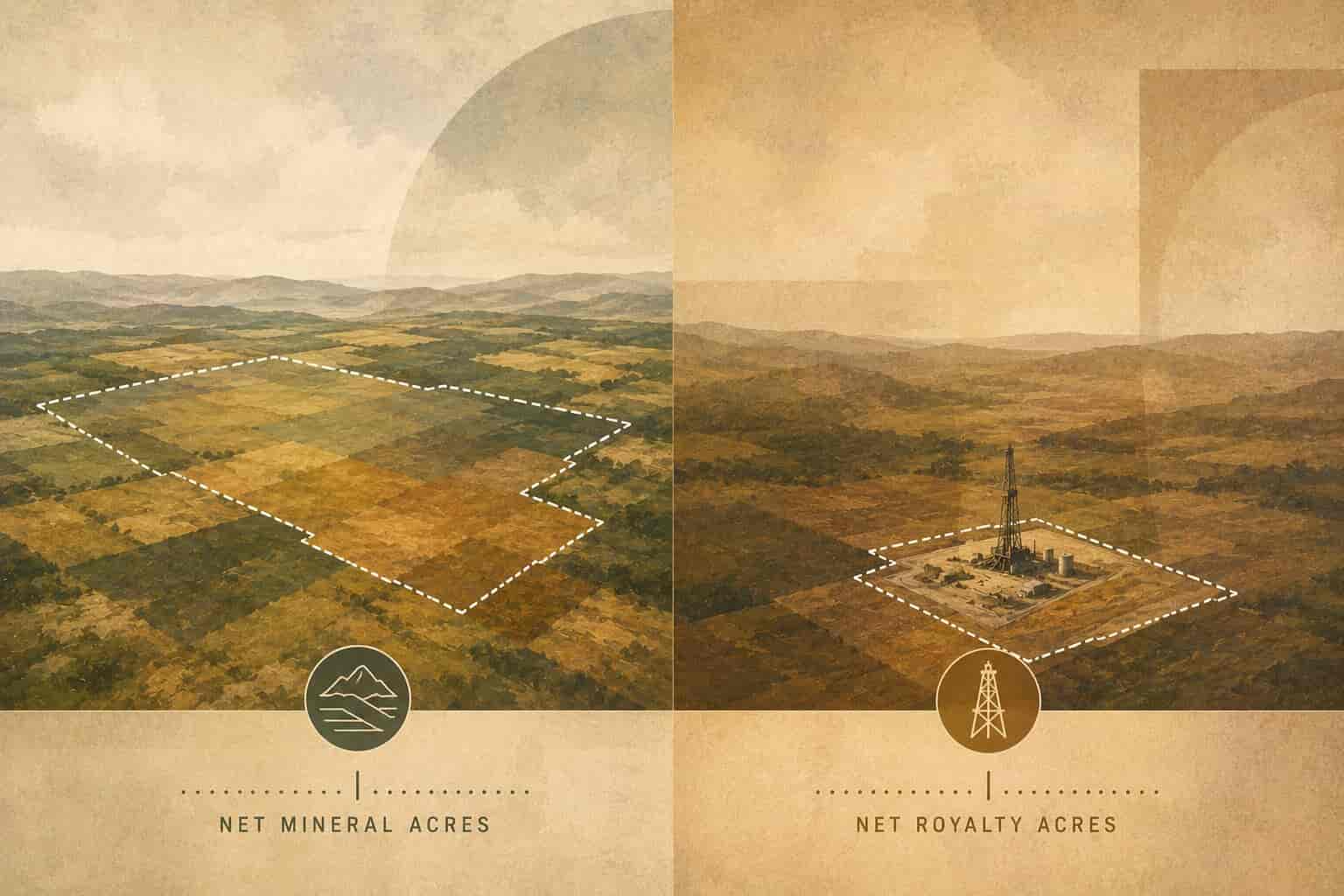
If you have started looking into what your minerals are worth, you have probably run into two phrases that sound almost interchangeable: net mineral acres and net royalty acres. They are not interchangeable. They measure different things, they are calculated differently, and mixing them up is one of the most common ways an owner ends up with a value that is off by a wide margin. This guide walks through both, slowly, with the actual arithmetic, so you can read your own paperwork and follow the math instead of taking anyone’s word for it.
We do this calculation every day on the acquisition side, so the goal here is to hand you the same tools we use. No dollar figures, just the acreage and decimal math that the dollar figures get built on top of.
Start with gross acres
Everything begins with the tract. A gross acre is simply a physical acre of land described in a deed or a survey. If a deed describes a 640-acre section, that is 640 gross acres, full stop. Gross acreage says nothing about how much of the minerals you own. It is just the size of the dirt.
This matters because owners sometimes see a large gross-acreage figure in an old deed and assume they own all of it. In reality, generations of inheritance and conveyance usually mean you own a fraction of the minerals under that tract, not the whole thing. To get from gross acres to what you actually hold, you need your fractional interest.
Net mineral acres (NMA)
A net mineral acre is your fractional mineral ownership translated into acres. It answers the question, “If you gathered up your scattered fractional interest and expressed it as whole acres of 100 percent mineral ownership, how many acres would that be?”
The formula is straightforward:
Net mineral acres = your fractional mineral interest × gross acres
A few worked examples make it concrete:
- You own one-quarter of the minerals under a 640-acre section. Your NMA = 0.25 × 640 = 160 net mineral acres.
- You own one-half of the minerals under an 80-acre tract. Your NMA = 0.50 × 80 = 40 net mineral acres.
- You inherited a one-sixteenth interest in a 320-acre tract. Your NMA = 0.0625 × 320 = 20 net mineral acres.
Net mineral acres are the cleanest measure of how much mineral ownership you hold, independent of any lease. They do not depend on your royalty rate, on whether the tract is leased, or on whether anything is producing. They are a pure statement of ownership: this is how much of the rock under that tract is yours. Because of that, NMA is the figure most acquisition conversations start from, and it is the number we ask about first when someone tells us what they own. For the deeper definition of the underlying fractional ownership, our glossary entry on the mineral deed covers how these fractions get written down and conveyed.
Why NMA can be hard to pin down
In theory NMA is simple multiplication. In practice the fraction can be buried. A century of inheritance, where each generation splits the interest among several heirs, can leave you with a fraction like 1/96 or 7/1280 that nobody ever wrote on a single clean page. Reconstructing it usually means tracing the chain of title back through the deeds, which is exactly the kind of work an abstract of title exists to capture. If your fraction is unclear, your NMA is unclear, and so is everything downstream of it.
Net royalty acres (NRA)
A net royalty acre measures something different. It measures the size of your royalty stream, standardized to a common royalty rate so that interests leased on different terms can be compared on the same footing.
Here is the problem NRA solves. Two owners can each hold the same net mineral acres but receive very different royalty streams, because they leased at different royalty rates. An owner leased at a one-eighth royalty receives a smaller share of production than an owner with identical acreage leased at a one-fifth royalty. If you only compared their net mineral acres, they would look identical, even though one royalty stream is much larger than the other. Net royalty acres fix this by normalizing everything to a standard rate.
The convention is to standardize to a one-eighth (12.5 percent) royalty, because historically one-eighth was the near-universal lease royalty. So:
One net royalty acre = the royalty from one net mineral acre leased at a one-eighth royalty.
That gives the conversion:
Net royalty acres = net mineral acres × (lease royalty rate ÷ 1/8)
Worked through:
- You own 160 NMA leased at a one-eighth (12.5%) royalty. NRA = 160 × (0.125 ÷ 0.125) = 160 NRA. At a one-eighth lease, NMA and NRA are the same number. This is the case that makes people think the two terms are interchangeable. They are only equal at this one royalty rate.
- You own 160 NMA leased at a one-fifth (20%) royalty. NRA = 160 × (0.20 ÷ 0.125) = 160 × 1.6 = 256 NRA. The same mineral acreage, leased on better terms, represents a larger royalty position.
- You own 160 NMA leased at a three-sixteenths (18.75%) royalty. NRA = 160 × (0.1875 ÷ 0.125) = 160 × 1.5 = 240 NRA.
The takeaway: net royalty acres rise and fall with your royalty rate, while net mineral acres do not. NRA is a measure of royalty size; NMA is a measure of mineral ownership. The royalty interest glossary entry has more on the royalty side of this, and our guide to reading an oil and gas lease covers where the royalty rate actually lives in your lease.
The decimal interest ties it to your check
Net mineral acres and net royalty acres are ways of describing the size of what you own. The number that actually determines what lands on your royalty check is the decimal interest, sometimes called the revenue interest or the division-order decimal. It is the precise fraction of a well’s production revenue that is yours.
For production from a pooled unit, the decimal interest comes together like this:
Decimal interest = (your net mineral acres ÷ unit acres) × your lease royalty rate
Walk it through. Say you own 160 net mineral acres that are pooled into a 640-acre drilling unit, and your lease carries a one-fifth (20%) royalty:
- Your share of the unit by acreage is 160 ÷ 640 = 0.25 (you hold a quarter of the unit’s minerals).
- Your royalty rate on that share is 0.20.
- Your decimal interest is 0.25 × 0.20 = 0.05.
That 0.05 is the fraction of the unit’s total production revenue that flows to you, cost-free, every month the unit produces. It is the number printed on your division order, and getting it right is the entire point of the exercise. Our glossary goes deeper on the decimal interest and how operators compute and verify it.
Notice that the decimal interest folds both ideas together. The acreage ratio (160 ÷ 640) reflects your net mineral acres against the unit. The royalty rate (0.20) is the same rate that drives your net royalty acres. So NMA, NRA, and the decimal interest are three views of the same underlying ownership: how much you own, how big your royalty is relative to a standard, and exactly what fraction of revenue hits your account.
A quick note on the working-interest side
Everything above describes a mineral and royalty owner, which is what most people we talk with are. The same acreage math also drives the operating side, but it lands differently. A working interest owner’s share of a unit is based on their net mineral acres relative to the unit too, but instead of a cost-free royalty, that share carries a proportional obligation to pay drilling and operating costs. The slice they keep after paying out the royalties burdening their interest is their net revenue interest. You generally only end up on this side of the math if you are pooled into a unit and elect to participate rather than take a royalty, a choice we cover in our guide to pooling orders. For most owners, the cost-free royalty math is the relevant one.
Why this matters when someone makes you an offer
When an interest is bought or sold, the price is almost always quoted per unit of acreage, and which unit matters enormously. An offer expressed per net royalty acre and an offer expressed per net mineral acre are using different denominators, and the same underlying interest will produce very different headline numbers depending on which one is used and what royalty rate is assumed.
This is where the confusion between the two terms stops being academic. If you do not know whether a quote is per NMA or per NRA, and at what assumed royalty, you cannot compare it to anything or sanity-check it. A few habits protect you:
- Know your fraction. Without your true fractional mineral interest, your NMA is a guess, and everything built on it is too.
- Know your royalty rate. It is the difference between NMA and NRA, and it comes straight from your lease.
- Ask which acre any quote refers to. Per net mineral acre or per net royalty acre, and at what royalty assumption. The same interest can be described both ways.
- Tie it back to the decimal. Your division-order decimal is the ground truth of what you actually receive. Any valuation should be reconcilable to it.
Our overview of how mineral rights are valued builds directly on this acreage math, and our guide to reading an offer carefully covers the questions worth asking when a number shows up in your mailbox.
Frequently asked questions
What is the difference between net mineral acres and net royalty acres?
Net mineral acres measure how much of the minerals under a tract you own, calculated as your fractional interest times the gross acres. Net royalty acres measure the size of your royalty stream, standardized to a one-eighth royalty so interests leased on different terms can be compared. The two are equal only when the lease royalty is exactly one-eighth. At any higher royalty, your net royalty acres exceed your net mineral acres.
How do I calculate my net mineral acres?
Multiply your fractional mineral interest by the gross acreage of the tract. If you own one-quarter of the minerals under a 640-acre section, you own 0.25 × 640 = 160 net mineral acres. The hard part is usually not the multiplication, it is pinning down your true fraction after generations of inheritance have divided the original interest.
Why is the one-eighth royalty used as the standard for net royalty acres?
Historically, one-eighth (12.5 percent) was the standard oil and gas lease royalty for most of the twentieth century, so it became the natural baseline for normalizing royalty interests. Modern leases often carry higher royalties, which is exactly why the standardization matters: it lets a one-eighth interest and a one-fifth interest be compared on a single common scale rather than being mistaken for the same thing.
What is a decimal interest and how does it relate to all this?
The decimal interest is the exact fraction of a well or unit’s production revenue that is paid to you. For a pooled unit, it equals your net mineral acres divided by the unit acres, multiplied by your lease royalty rate. It is the number on your division order and the figure that actually determines your check. NMA and NRA describe the size of your ownership; the decimal interest is what that ownership turns into as a share of revenue.
Can I have net royalty acres without net mineral acres?
You can hold a royalty stream without holding the full mineral interest, which is what a non-participating royalty interest is. In that case you have a royalty position (and a royalty-acre figure) without the executive and bonus rights that come with a full mineral interest. Sorting out whether you hold minerals or only a royalty is an important first step, because it changes both the math and the value.
Should I trust an online calculator for these numbers?
The arithmetic itself is reliable, so a calculator can do the multiplication fine. The risk is in the inputs. If your fractional interest, your gross acreage, or your royalty rate is wrong or assumed, the output is wrong no matter how clean the formula. The figures that drive real value come from your deeds, your lease, and your division order, not from a default assumption. We are happy to check the math with you against your actual paperwork.
Where to go from here
If you want to put this to work, pull three documents: the deed or deeds that establish your fractional interest, the lease that sets your royalty rate, and the most recent division order that shows your decimal. Between them you can compute your net mineral acres, your net royalty acres, and confirm your decimal interest, and you will be reading any future offer with clear eyes.
If the fractions are tangled, or you would simply rather have someone run the numbers with you, that is squarely the kind of thing we help with. We will work through the acreage and decimal math against your real documents and tell you plainly what we see, and if you ever decide to sell, our overview of selling mineral rights covers the process. You can start a conversation whenever you are ready, with no obligation attached.