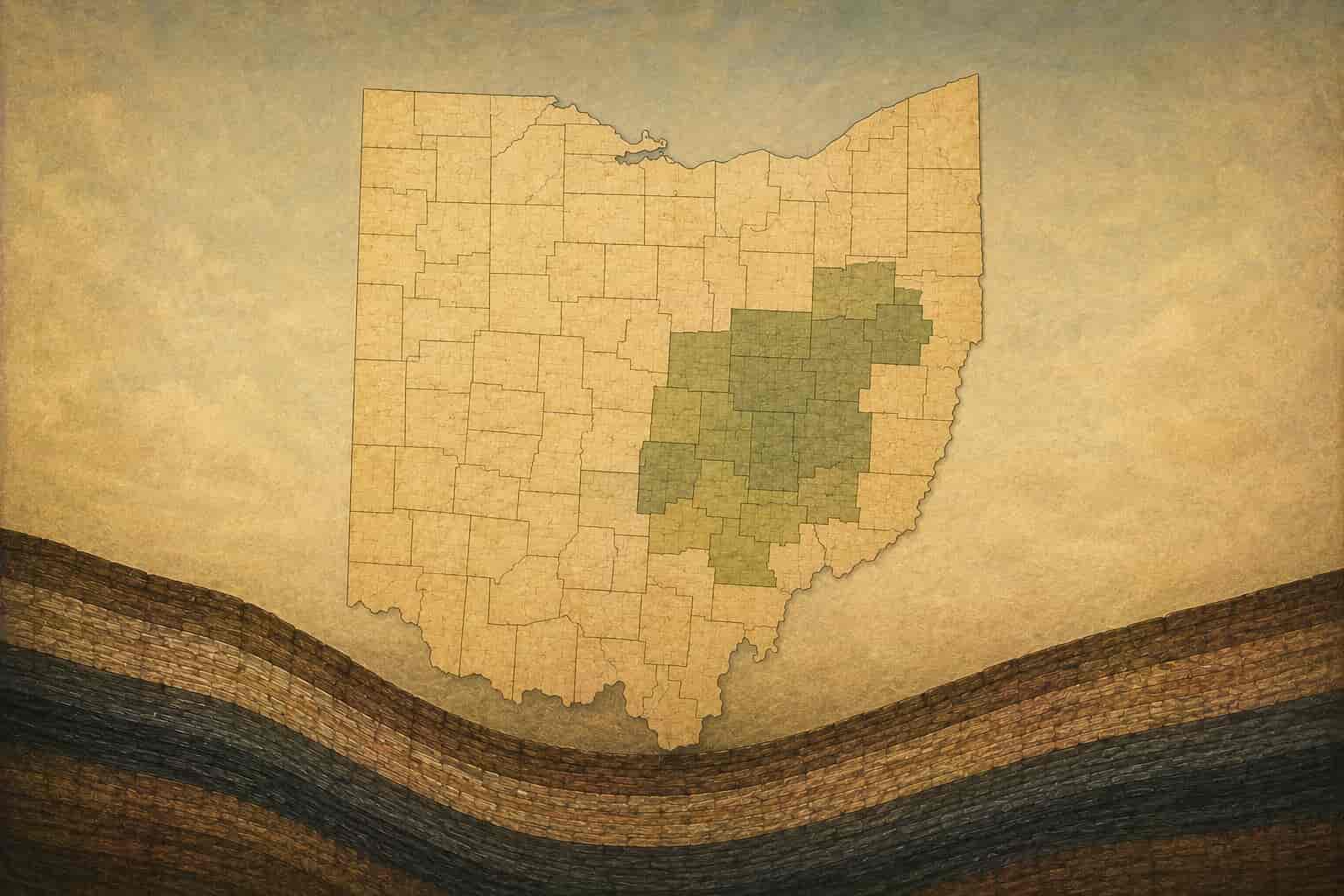
If you own, or think you might own, severed mineral rights under land in eastern Ohio, the Ohio Dormant Mineral Act is one of the most important things to understand. It is the law that can transfer dormant mineral interests from the mineral owner to the surface owner above, and over the past decade it has reshaped who owns the minerals across the Utica Shale counties.
This guide explains what the Dormant Mineral Act is, how a mineral interest becomes dormant, how the reclamation process works step by step, the deadlines that matter, and what a mineral owner should do to protect an interest. It is general education for mineral owners and their families, not legal advice. The Dormant Mineral Act is genuinely technical and the case law is still developing, so anyone with a real interest at stake should talk to an Ohio oil and gas attorney.
What the Ohio Dormant Mineral Act is
Ohio has two related laws that affect old, unused mineral interests: the Marketable Title Act and the Dormant Mineral Act. The Dormant Mineral Act, found in Ohio Revised Code section 5301.56, is the one most mineral owners encounter. It provides a way for the owner of the surface to have an abandoned, severed mineral interest declared dormant and merged back into the surface estate.
The underlying idea is a policy choice the Ohio legislature made years ago. When minerals are severed from the surface (sold or reserved separately, often generations ago) and then sit unused, untracked, and unclaimed for a long stretch of time, the law provides a mechanism to clear that stale interest off the title so the land can be developed. Without a way to resolve dormant interests, a surface owner could be unable to lease for oil and gas because the mineral ownership trail went cold a century ago.
For a mineral owner, the same law cuts the other way: if your family’s mineral interest goes dormant and you do nothing, a surface owner can take steps to reclaim it. Understanding the rules is how you avoid losing an interest you did not know was at risk.
What “severed” and “dormant” actually mean
Two concepts sit at the heart of the Act.
A severed mineral interest is mineral ownership that has been separated from the surface ownership. This happens when a prior owner sells the land but keeps (reserves) the minerals, or sells the minerals but keeps the surface. After a severance, two different parties own two different estates in the same ground: one owns the surface, one owns the minerals beneath it. Severances in eastern Ohio frequently date back to the early or mid twentieth century, which is why so many current mineral owners inherited their interest without ever knowing the land.
A mineral interest becomes a candidate for being declared dormant when, for a continuous statutory period (twenty years), none of the “savings events” the law recognizes has occurred. In plain terms, dormancy means the interest has shown no recorded sign of life for twenty years: no production, no recorded transfer, no recorded claim to preserve it, and so on. The specific savings events are the key, and we cover them below.
The savings events that keep an interest alive
The Dormant Mineral Act lists specific things that, if any one of them happened within the relevant twenty-year window, keep the mineral interest from being treated as abandoned. If your interest experienced any of these, it is not dormant. The recognized savings events include:
- The mineral interest was the subject of a title transaction that was recorded in the county recorder’s office (for example, a deed or other recorded conveyance referencing the minerals).
- There was actual production or withdrawal of oil, gas, or other minerals under the interest, or it was used in underground gas storage.
- A drilling or mining permit was issued for the interest.
- A claim to preserve the mineral interest was recorded (this is the affirmative step a mineral owner can take, described later).
- A separately listed tax parcel number was created for the mineral interest, or taxes were separately assessed on it.
If at least one of these occurred in the twenty years before the surface owner began the abandonment process, the interest stays with the mineral owner. The whole dispute in most Dormant Mineral Act cases comes down to whether a qualifying savings event happened inside the window.
The 2006 dividing line and why dates matter so much
The Dormant Mineral Act was originally enacted in 1989 and then significantly amended effective June 30, 2006. The difference between the original version and the 2006 version became one of the most litigated questions in Ohio oil and gas law.
The Ohio Supreme Court ultimately resolved much of this in a series of decisions, most notably Corban v. Chesapeake Exploration in 2016. The Court held that the 2006 version of the Act applies going forward, and that a surface owner who wants to claim an abandoned mineral interest must use the notice-and-record process the 2006 amendments require. The earlier 1989 version does not automatically vest abandoned minerals in the surface owner without that process.
The practical takeaway for a mineral owner is that the precise dates, the version of the statute in play, and the sequence of recorded events all matter enormously. This is exactly the kind of issue where an attorney who handles these cases earns their keep, because the outcome can turn on a single recorded document and the twenty-year lookback measured from it.
How a surface owner reclaims a dormant interest, step by step
Under the 2006 version, a surface owner who believes a severed mineral interest is abandoned cannot simply take it. The Act requires a defined process, and each step has consequences for the mineral owner.
Step one: the surface owner serves notice of intent to declare abandonment. The surface owner must serve notice on the holders of the mineral interest (and their successors or assignees) of the intent to declare the interest abandoned. Service is by certified mail when an address is known, and by publication in a newspaper of general circulation in the county when the holder cannot be identified or located. This notice is the mineral owner’s warning that the clock is running.
Step two: the mineral owner has a window to respond. After notice, the mineral owner has a statutory window (sixty days) to do one of two things: record a claim to preserve the mineral interest, or record an affidavit identifying a qualifying savings event that occurred within the relevant period. Either filing, made in time, stops the abandonment.
Step three: if the mineral owner does nothing, the surface owner records the abandonment. If the mineral owner files nothing within the window, the surface owner may record an affidavit of abandonment. At that point, the mineral interest is treated as abandoned and merged into the surface estate, and the surface owner becomes the owner of the minerals.
Because the entire mechanism depends on notice and a short response window, a mineral owner who is paying attention can almost always preserve an interest. The owners who lose interests under the Act are usually those who never received or never opened the notice, often because the interest passed through several generations and the operator or surface owner had only an outdated address.
What a mineral owner should do to protect an interest
If you hold, or suspect you hold, a severed mineral interest in eastern Ohio, there are concrete steps that reduce the risk of losing it to dormancy.
Confirm what you own and where. Track down the deed or reservation that created the interest, the county, and the parcel it sits under. Our guide for people who recently inherited mineral rights walks through how to start when you have little to go on. The Ohio county recorder’s office where the land sits holds the recorded chain of title.
Keep your address current with operators and the county. Many interests are lost simply because notice went to a decades-old address. If your minerals are leased or producing, make sure the operator has your current contact information. Keeping in touch with how your minerals are administered is part of what a mineral owner is responsible for.
Consider recording a claim to preserve. The Act lets a mineral owner record a claim to preserve the mineral interest, which itself is a savings event and resets the dormancy analysis. Filing one proactively, before any abandonment notice, is a recognized way to keep an interest clearly alive. An Ohio attorney can prepare and record it correctly.
Act immediately if you receive a notice of intent to declare abandonment. This is the one that matters most. If a certified letter or a published notice says a surface owner intends to declare your mineral interest abandoned, the response window is short and the consequence of missing it is losing the minerals. Do not set it aside. Contact an attorney promptly so a claim to preserve or an affidavit of a savings event can be recorded in time.
How the Dormant Mineral Act intersects with leasing and value
The reason the Dormant Mineral Act matters so much in Ohio is timing. The dormancy fights of the 2010s lined up with the Utica Shale boom across Belmont, Monroe, Harrison, Guernsey, Jefferson, Noble, and Carroll counties. Suddenly, mineral interests that had been worthless and forgotten for generations were worth leasing, and surface owners and mineral heirs both had reasons to claim them.
For a mineral owner, a clean, clearly preserved interest is also a more valuable and more easily conveyed one. Title questions raised by dormancy can complicate a lease or a sale, because a buyer or operator wants confidence about who actually owns the minerals. If you are weighing a sale, the tax side of selling mineral rights is worth understanding too, particularly the stepped-up basis that often applies to inherited interests.
You can also see how the Utica plays across the region in our guide to the Utica Shale for mineral owners, and our Ohio inheritance guide covers the Dormant Mineral Act alongside the Marketable Title Act and Ohio probate practice.
Common questions about the Ohio Dormant Mineral Act
Does the Dormant Mineral Act apply to all minerals, or just oil and gas? The Act applies broadly to severed mineral interests, but in practice the disputes that reach the courts are almost entirely about oil and gas, because that is what made dormant interests valuable in eastern Ohio.
How long does a mineral interest have to be dormant? The statute uses a twenty-year period of no qualifying savings events. The hard part is rarely the twenty years itself; it is identifying whether a savings event occurred and exactly when, because that determines the window.
I just got a certified letter about abandoning my minerals. How long do I have? The response window after notice is short (sixty days under the 2006 version). Recording a claim to preserve or an affidavit of a savings event within that window stops the abandonment. Because the deadline is firm, this is the moment to call an Ohio attorney rather than wait.
Can I lose minerals I never knew I had? Yes, which is the hard reality the Act creates. Interests passed down through several generations are the ones most at risk, because notice often goes to an old address and the heirs never see it. Confirming and preserving an interest you suspect you hold is the protection.
What is the difference between the Dormant Mineral Act and the Marketable Title Act? Both can extinguish old severed interests, but they work differently. The Marketable Title Act can extinguish an interest automatically after a long period if it is not referenced in the chain of title, while the Dormant Mineral Act requires the notice-and-record process described above. Ohio courts have addressed how the two interact, and which one controls in a given fact pattern is an attorney-level question.
Do I need a lawyer? For anything with real value at stake, yes. The Dormant Mineral Act turns on recorded documents, exact dates, and evolving case law. This guide is education, not legal advice, and the cost of getting a deadline or a savings-event analysis wrong is losing the minerals.
If you are trying to sort out an Ohio mineral interest
If you inherited or suspect you hold a severed mineral interest in eastern Ohio, and you are trying to figure out whether it is at risk, what it might be worth, or what to do next, we are happy to help you think it through. We work with owners across the Utica counties, and a short conversation often clarifies where you stand and what the sensible next step is. We will always point you to a qualified Ohio attorney for the legal filings, because that is what protecting a real interest requires.